CRC

Disease State

Colorectal cancer (CRC) is a leading cause of cancer deaths for men and women globally.1​ Given its significant public health impact, it is critical to better understand its distinct biology and develop effective treatments.1​

Patient and Disease Characteristics

Epidemiology

Screening for CRC has likely led to earlier diagnoses, and as such may be responsible for the decrease in diagnosis and mortality rates in older adults. However, diagnosis and mortality rates remain a persistent challenge.2​

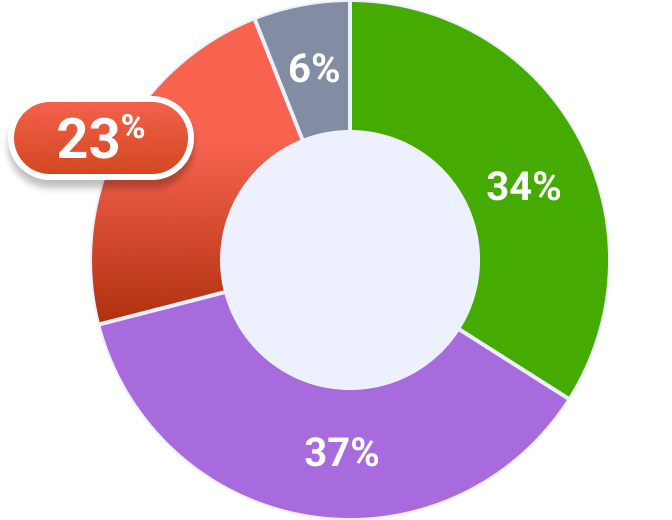
Percent of Cases by Stage at Diagnosis3

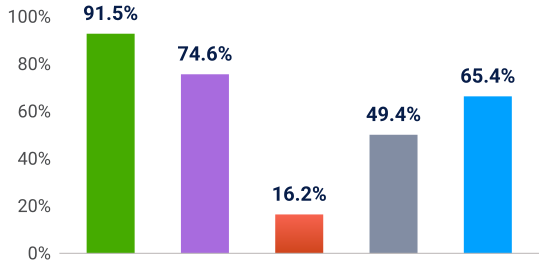
5-year Relative Survival by Stage at Diagnosis3

Localized
Regional
Distant
Unknown
5-year Relative Survival (all stages)

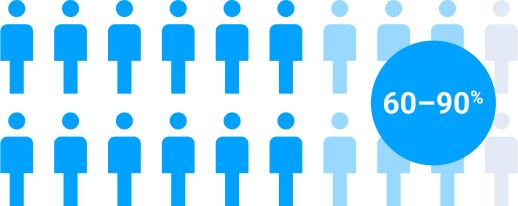
CRC rates have steadily risen among younger adults, particularly those aged 55 and under, with many cases diagnosed at an advanced stage.2,3 A significant proportion present with distant disease, which carries a poor 5-year survival rate.2,3 Approximately 60–90% of CRC tumors harbor actionable genomic alterations (AGAs).1​

Pathobiology

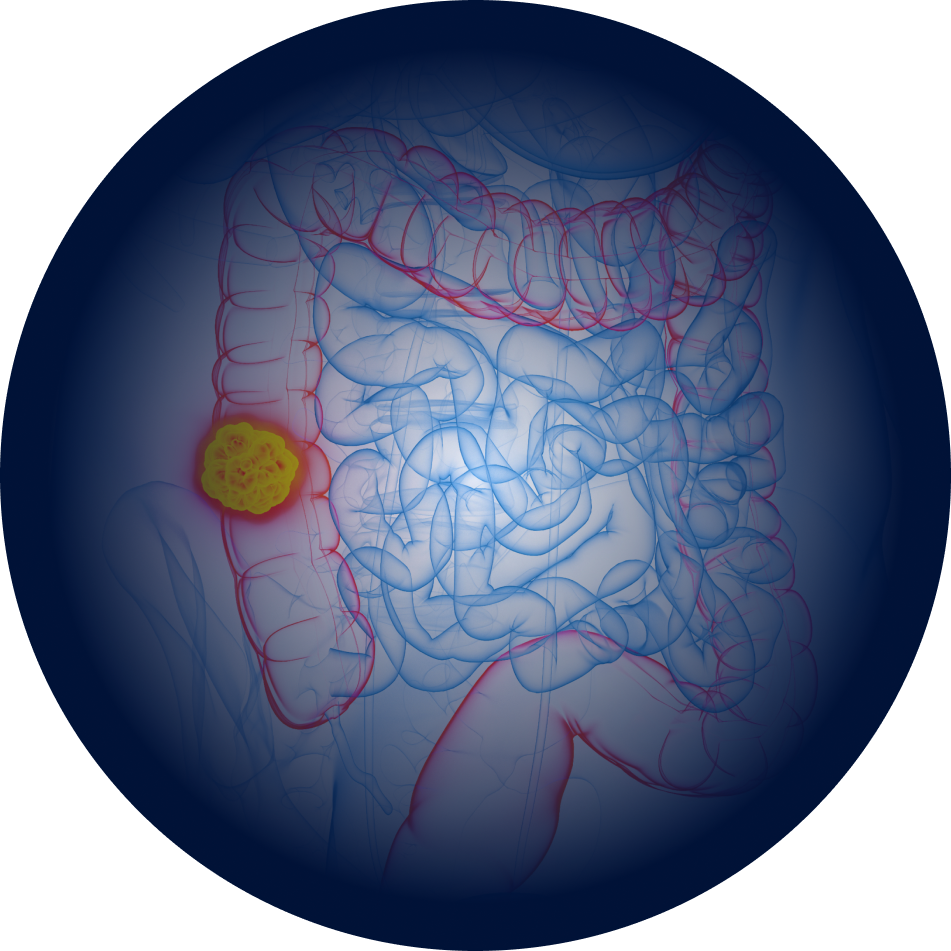
CRC typically begins with a polyp4

The development of colorectal cancer often begins with polyps that acquire mutations in genes that regulate cell proliferation and tumor suppression.

Uncontrolled cell growth is driven by mutations in genes like p53 and KRAS4

Alterations in tumor suppressors like p53 or drivers of proliferation like KRAS can lead to uncontrolled growth and the formation of malignant adenocarcinomas.

In many CRC tumors, genomic aberrations disrupt the DNA mismatch repair system, resulting in deficient MMR (dMMR) and high MSI (MSI-H)4,5

Genomic aberrations like dMMR and MSI-H in adenocarcinomas are associated with a more positive prognosis following immunotherapy.

Patient and Disease Characteristics

Patient care in CRC relies on the understanding that each patient’s disease is unique. In CRC, testing for tumor and molecular characteristics, such as MMR and circulating tumor cells (CTC), is essential at all stages to help inform the patient care strategy. However, upon metastatic progression, actionable biomarkers should be examined.6-8

Patient Care Plan

Patient history and characteristics9

Stage of disease8​

CRC subtypes10

Tumor and molecular characteristics6-8,10

Genetics
Age
Type 2 diabetes
Obesity
Family history
Early stage
Locally advanced
Metastatic
Colorectal adenocarcinoma
Gastrointestinal carcinoid tumors
Gastrointestinalstromal tumors
MMR and MSI
Actionable biomarkers
ctDNA

Patient history and characteristics9

Genetics
Age
Type 2 diabetes
Obesity
Family history

Stage of disease8​

Early stage
Locally advanced
Metastatic

CRC subtypes10

Colorectal adenocarcinoma
Gastrointestinal carcinoid tumors
Gastrointestinalstromal tumors

Tumor and molecular
characteristics6-8,10

MMR and MSI
Actionable biomarkers
ctDNA
AGAs=actionable genomic alterations; CRC=colorectal cancer; ctDNA=circulating tumor DNA; KRAS=Kirsten rat sarcoma virus; MMR=mismatch repair; MSI=microsatellite instability; p53=tumor protein 53.

Learn more about select biomarkers in CRC

References
1. Jan YH, et al. Br J Cancer. 2022;127(7):1304-1311. doi:10.1038/s41416-022-01913-4. 2. American Cancer Society. Colorectal Cancer Statistics. April 28, 2025. Accessed August 12, 2025. https://www.cancer.org/cancer/types/colon-rectal-cancer/about/key-statistics.html. 3. National Cancer Institute, Surveillance, Epidemiology, and End Results Program. Cancer Stat Facts: Colorectal Cancer. Accessed August 12, 2025. https://seer.cancer.gov/statfacts/html/colorect.html. 4. Kasi A, et al. Curr Colorectal Cancer Rep. 2020;16(5):97-106. doi:10.1007/s11888-020-00458-z. 5. Parente P, et al. Dig Dis. 2023;41:746-756. doi:10.1159/000531003. 6. Grillo, et al. Histochem and Cell Biol. 2023;160(2):113-115. doi:10.1007/s00418-023-02202-8. 7. Adekunle AD, et al. JAMA Netw Open. 2024;7(7):e2419110. doi:10.1001/jamanetworkopen.2024.19110. 8. American Cancer Society. Colorectal Cancer Early Detection, Diagnosis, and Staging. January 29, 2024. Accessed August 15, 2025. https://www.cancer.org/cancer/types/colon-rectal-cancer/detection-diagnosis-staging/staged.html. 9. American Cancer Society. Colorectal Cancer Risk Factors. April 29, 2025. Accessed August 15, 2025. https://www.cancer.org/cancer/types/colon-rectal-cancer/causes-risks-prevention/risk-factors.html. 10. American Cancer Society. About Colorectal Cancer. January 29, 2024. Accessed August 15, 2025. https://www.cancer.org/cancer/types/colon-rectal-cancer/about/what-is-colorectal-cancer.html.

    References
    1. Remon J, Hendriks LEL, Mountzios G, et al. J Thorac Oncol. 2023;18(4):419-435. doi:10.1016/j.jtho.2022.10.015.
    2. Han Y, Yu Y, Miao D, et al. JTO Clin Res Rep. 2024;5(2):100630. doi:10.1016/j.jtocrr.2023.100630.
    3. Altintas DM, Comoglio PM. Cancers (Basel). 2023;15(18):4672. doi:10.3390/cancers15184672.
    4. Liang H, Wang M. Onco Targets Ther. 2020;13:2491-2510. doi:10.2147/OTT.S231257.
    5. Park S, Choi YL, Sung CO, et al. Histol Histopathol. 2012;27(2):197-207. doi:10.14670/HH-27.197.
    6. Sun W, Song L, Ai T, et al. J Biomed Res. 2013;27(3):220-230. doi:10.7555/JBR.27.20130004.
    7. Socinski MA, Pennell NA, Davies KD. JCO Precis Oncol. 2021;5:PO.20.00516. doi:10.1200/PO.20.00516.
    8. Drusbosky LM, Dawar R, Rodriguez E, Ikpeazu CV. J Hematol Oncol. 2021;14(1)129. doi:10.1186/s13045-021-01138-7.
    9. Sierra JR, Tsao MS. Ther Adv Med Oncol. 2011;3(1 Suppl):S21-35. doi:10.1177/1758834011422557.
    10. Yin W, Guo M, Tang Z, et al. Cancers (Basel). 2022;14(10):2433. doi:10.3390/cancers14102433.
    11. Ding C, Qiu Y, Zhang J, et al. BMC Pulm Med. 2023;23(1):240. doi:10.1186/s12890-023-02482-9.
    12. Coleman N, Hong L, Zhang J, et al. ESMO Open. 2021;6(6):100319. doi:10.1016/j.esmoop.2021.100319.
    13. Settleman J. Curr Biol. 2012;22(2):R43-4. doi:10.1016/j.cub.2011.11.004.
    14. Qin K, Hong L, Zhang J, et al. Cancers (Basel). 2023;15(3):612. doi:10.3390/cancers15030612.
    15. Hartmaier RJ, Markovets AA, Ahn MJ, et al. Cancer Discov. 2023;13(1):98-113. doi:10.1158/2159-8290.CD-22-0586.
    16. Xiang C, Lv X, Chen K, et al. Mod Pathol. 2024;37(4):100451. doi:10.1016/j.modpat.2024.100451.
    17. Heydt C, Ihle MA, Merkelbach-Bruse S. Cancers (Basel). 2023;15(11):2932. doi:10.3390/cancers15112932.
    18. Mazieres J, Vioix H, Pfeiffer BM, et al. Clin Lung Cancer. 2023;24(6):483-497. doi:10.1016/j.cllc.2023.06.008.
    19. Reischmann N, Schmelas C, Molina-Vila MA, et al. iScience. 2023;26(7);107006. doi:10.1016/j.isci.2023.107006.
    20. Friedlaender A, Drilon A, Banna GL, et al. Cancer. 2020;26(22):4826-4837. doi:10.1002/cncr.33159.